

.png?width=1080&height=169&name=PROMPT%20framework%20download%20(3).png)
Generic prompts yield generic results. In the fast-paced world of PR and executive productivity, AI should be treated like a team member, not a search engine. If you wouldn't give a junior staffer a vague, one-sentence brief and expect a front-page result, you shouldn't expect it from your AI.
The gap between a mediocre AI response and a high-impact output usually comes down to how you frame the request. To move past the "AI fluff" and get results that actually work for your brand, you need a structured way to brief the machine.
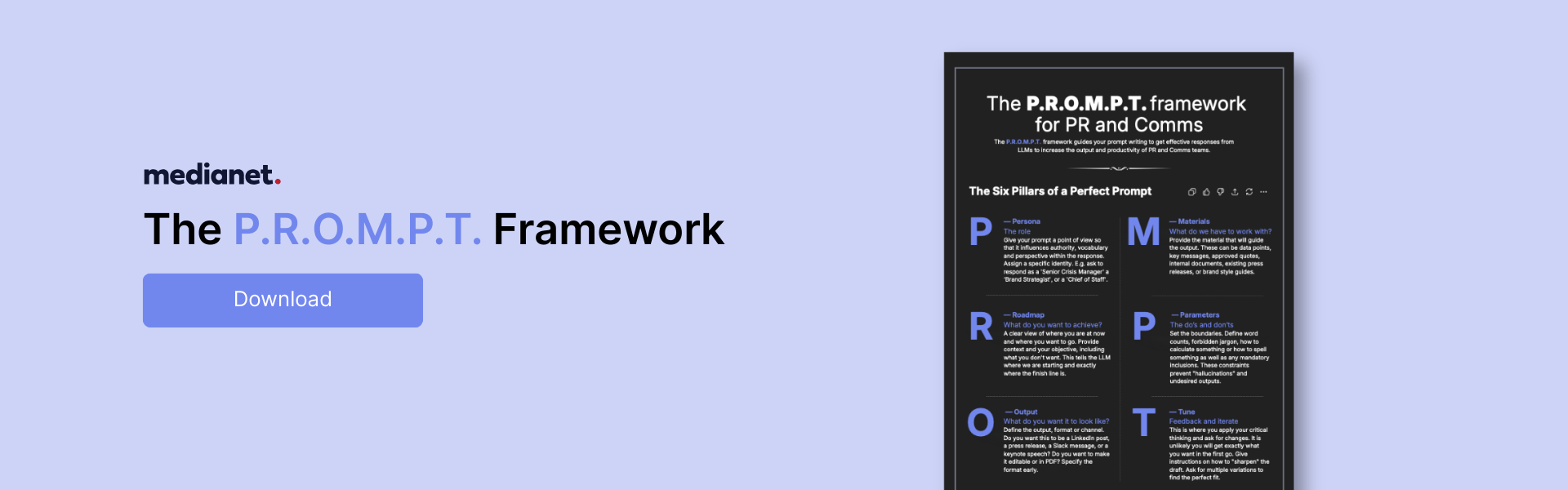
The P.R.O.M.P.T. framework is designed to bridge that gap, turning vague ideas into effective, professional responses that increase your daily output and productivity. In this article we’ll share the 6 pillars of the framework and give you some of our expert tips for getting the most out of each prompt.
The Six Pillars of a Sharp Prompt
P – Persona (The role)
Assign a specific identity to your AI. Don't just ask for "writing"; ask for a Senior Crisis Manager, a Brand Strategist, or a Chief of Staff. This locks in the authority, vocabulary, and perspective you need for the task.
R – Roadmap (What do you want to achieve?)
AI needs to know the "why" behind the "what." By providing Context about where you are and your Objective (where you want to go), you give the LLM a clear view of what to do and what not to do. This tells the AI exactly where the starting line and the finish line are.
O – Output (What do you want it to look like?)
Define the channel clearly. A LinkedIn post has a completely different DNA than a keynote speech or a pitch to an editor. Specify the format and the tone early in the conversation.
M – Materials (Reference and inspiration)
Provide the material that will guide the output. Include specific data points, quotes, examples for inspiration, or a report with a tone you want the AI to emulate.
P – Parameters (Set the boundaries)
Set the boundaries. Define word counts, forbidden jargon, or mandatory inclusions. These constraints are what prevent "hallucinations" and off-brand fluff.
T – Tune (Don't be too polite)
This is where you apply your critical thinking. It is unlikely you will get exactly what you want on the first go. Give instructions on how to "sharpen" the draft or ask for multiple variations to find the perfect fit.
Prompting tips from our team
- LLMs are designed to be sycophantic. They will agree to whatever you propose. Remember you are the boss. If you were briefing a team member and that work did not match your expectations, what would you say? Don’t treat AI any differently just because it’s a machine.
- Another way to get around this is to tell your AI to be critical. Ask it “Be critical and tell me everything that is wrong with my suggestion and why I should not go ahead”. Followed by “Tell me every reason why I should go ahead”. Or “Give me pros and cons of going ahead with this version”. This gives both you and the AI a chance to sanity check the output and pick up anything that might be wrong.
- You don’t have to have a perfect prompt or perfect response each time. Once you get the first output, you will rarely get the perfect answer on the first go, not even on the third one. But you can have a conversation expressing your raw thoughts to indicate if the response is right or needs work. For example, if the output is far off from what you expected you can say “This is not what I was expecting, I was expecting something more… and for you to mention this specifically”. Or you can even say “Oh no….try again!”
In a nutshell
The P.R.O.M.P.T. framework isn't about being a "prompt engineer," it’s about being a better manager. When you stop "searching" and start "briefing," you’ll find that AI can become one of your most productive team members.
Want to keep this framework on your desk or save it for when you need it? Download the P.R.O.M.P.T. framework below.
About the Author

Mercedes Carrin
Mercedes is passionate about purpose-led marketing initiatives that help businesses and their audience build relationships. Over more than 15 years she has executed effective marketing campaigns within the media, advertising and public relations industries leveraging the power of storytelling, technology and data. Based in Sydney, Mercedes was formerly Marketing Manager at Australian Associated Press (AAP) which has given her a unique perspective of the Australian and New Zealand media landscape.
Share




 Top
Top