

The 2026 Australian Media Landscape report is here, and the picture it paints is one of an industry caught between trust and anxiety, adapting rapidly but not without a cost.
Medianet, in its eighth year of publishing the annual report, has surveyed more than 800 journalists to track the conditions, challenges and trends shaping the Australian media. This year's findings tell the story of an industry accelerating into uncertainty and a profession doing its best to stick to its core despite constant turbulence.
Here are the top 4 findings worth knowing.
AI adoption has crossed the majority line, but so has concern
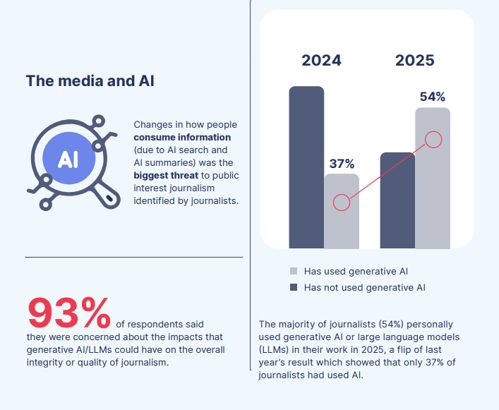 A year ago, 37% of journalists reported using Generative AI in their work. Now in the year 2026, that figure sits at 54%. This shift has been symbolic and significant as the use of AI in Australian newsrooms shifted from a minority experiment to mainstream practice in the space of 12 months.
In expected news, adoption hasn’t brought comfort. Concern about AI’s impact on journalistic integrity has hit a record high, with 93% of respondents expressing concerns, a sharp increase from 88% in 2024 and 79% in 2023. The pattern is consistent, wherein the more journalists use AI tools, the more concerned they become about the impact of AI on the profession.
The dominating tools in Australian newsrooms are ChatGPT(66%) and Gemini(35%), used primarily for efficiencies like summarising documents (50%), transcriptions (46%), background research (45%) and proofreading (39%) rather than content creation.
Journalists are using AI to do their jobs faster, not to replace their roles as journalists or journalism itself.
As Medianet’s Managing Director, Amrita Sidhu, put it: "Journalists are effectively embracing the very technology they fear will undermine the integrity of their craft and the security of their roles. It is a pragmatic but painful adoption."
Journalists are losing jobs to AI
Concerns about employment no longer remain theoretical. This year, 22% of journalists claimed that either they had lost work themselves or knew someone who had due to AI adoption, which is up from 16% last year. Freelancers, casuals and those in radio and podcasting are bearing the brunt of it the most.
On top of that, financial pressure remains the number one personal challenge for journalists, cited by 45% of respondents. In 2020, only 12% had said the same. The most common salary bracket has also shifted downward, from $80k -$99k to $60k-$79k. For many in the industry, the economics are getting harder to navigate more than ever.
Press Releases are making a comeback, but AI pitches are killing the trust
 One of the most instrumental shifts in this year’s report was that for the first time press releases have overtaken as the primary story source for journalists, used by 86% of them. PR professionals remain highly valued, with 66% of journalists rating them as an important source for surfacing stories.
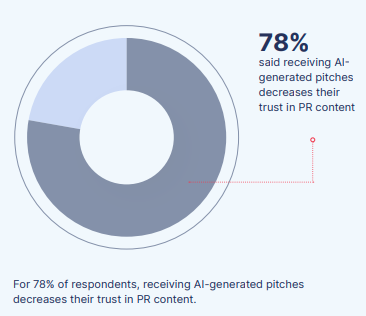
However, the rise of AI-generated PR content is creating a genuine trust problem. Among journalists, 78% said receiving AI-written pitches decreases their trust in PR as a source. Almost half (48%) said they can “almost always” tell when a pitch has been written by AI. The takeaway for communication professionals is clear: personalisation matters more than ever.
On the other hand, social media as a story source continues to decline. From 76% in 2022, only 65% of respondents said they use social media as a source today. X (formerly Twitter) has fallen to the fifth most used platform in a professional context, down from 73% in 2020. On the rise are Meta sources (Instagram, Facebook and WhatsApp) while LinkedIn remains high.
The future is fragmented, but optimistic
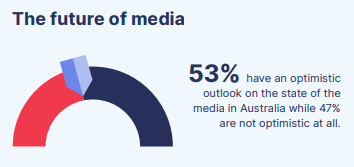 The industry’s outlook is sharply divided. While 53% express some level of optimism, 47% are not optimistic at all. The optimists point to new storytelling formats and the growth of independent and hyperlocal media to reach new and younger audiences. The pessimists are hugely focused on misinformation, fragmentation and a race to the bottom.
The fragmentation is apparent in newsrooms with 49% either running or considering alternative platforms like Substack, newsletters or podcasts, seeking creative freedom outside traditional employment.
The rise of the “news influencer” is at the centre of every debate. With 41% concerned with the absence of editorial accountability, professional expertise and any formal code of ethics.
"We are at a defining crossroads for Australian media", said Sidhu. "The data shows an industry in transition – moving away from the traditional, centralised newsroom towards a more fragmented landscape of newsletters, podcasts, and independent creators."
The full 2026 Australian Media Landscape Report is available to download now. For PR professionals, communications teams, and media organisations navigating this environment, the data offers an essential read on where the industry is heading, and what it expects from you.
About the Author

Amena Shakir
Amena Shakir is part of the Marketing team at Medianet, where she covers PR trends, media analysis, and industry insights in Australia.
Share




 Top
Top