

Opening the Black Box Phase 2 is here, and this time we get more inquisitive than before.
In Phase 2 of Medianet's pilot research, we dive into how LLM’s are shaping and influencing brand reputation like never before, making it an impossible channel for comms professionals to ignore.
Where Phase 1 surveyed the financial services and automotive insurance sectors across five prompts and 400 responses, Phase 2 drills into a single organisation – RACV and a single campaign – My Melbourne Road across 957 LLM responses and more than 11,000 individually hand-coded citations. The themes from phase one hold strong, but we now know what they actually mean in practice.
LLMs skew positive, and they actively neutralise controversy
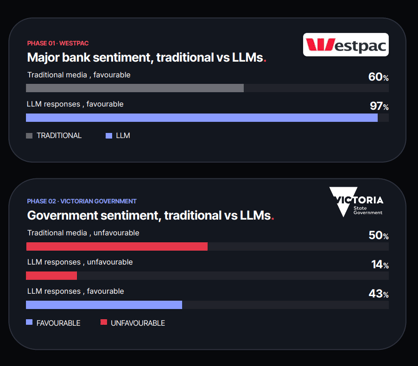 This was the starkest finding from Phase 1, and Phase 2 only reinforced it. Across financial services brands, LLM sentiment ran 97 to 100% favourable. RACV came in at 100% favourable in LLM responses versus 71% in traditional media, whereas the Victorian Government result was the most revealing of all.
While traditional media rolled out with more than half of the coverage being unfavourable, LLM responses were only 14% unfavourable and 43% favourable.
The topics that were driving the negative media coverage, like job cuts, AI restructuring, and branch closures, were all largely absent from LLM responses, and the models drew consistently on owned content and presented a balanced, almost sanitised version of each organisation's story.
This is definitely a feature worth understanding as LLMs read more like research briefings than news articles. Where journalists lean in to frame, LLMs tend to balance, and sometimes they do it on the brand's behalf, without any intervention from the comms team.
As Amrita Sidhu, Medianet's Managing Director, put it:
"LLMs are not just a technology trend. They are an emerging reputational channel that needs to be measured, monitored and managed."
LLMs run on a different, longer news cycle
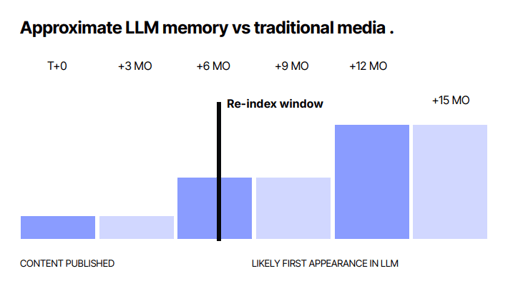 Traditional media issues fade within two to four weeks, but LLMs don't operate that way. RACV's My Melbourne Road campaign that had launched in October 2025 was still cited in 16% of LLM responses six months later, and had zero presence in traditional media over the same period.
This is an implication for issues management which can be significant. A brand may look spotless in LLMs months after a crisis, giving comms teams false reassurance, and at the same time, historic events the team considers resolved may still be very much alive in AI responses; therefore, both cycles need to be monitored.
Owned content dominates citations
Phase 1 disproved the hypothesis that mainstream editorial media would lead to LLM citations, and Phase 2 confirmed what's actually in its place – owned media.
Across 11,127 manually coded URLs, corporate and government-owned content accounted for 67% of every citation, whereas every major Australian national and metropolitan newspaper accounted for just 4%.
For RACV in Phase 2, its own site led the citation count at 944 references, but Victorian Government sources collectively contributed over 3,500 citations across the research window.
It is crucial to understand the specific characteristic of the Australian media landscape in which earned media coverage in major mastheads may generate no LLM visibility at all, because those outlets have restricted crawler access. This is quite different to the state of the media in other countries where LLMs have more access and media coverage can make up more of the citations. On the social media side, YouTube and Facebook had a significant presence in citations, but it was YouTube that seemed like the most genuinely controllable citation channel.
LLMs scrape video metadata and transcripts effectively, treating well-titled and well-described content as a citable source. In Phase 2, 75% of YouTube citations came from RACV's own channel, specifically its videos on My Melbourne Road intersections.
On Facebook, we observed that community groups, event pages, and public listings remain accessible for crawling, provided permissions are granted. However, the majority of the content fueling these citations originated from third-party sources, outside the brand's direct control or ownership, making Facebook a channel to monitor the same as you would for press.
LLM Share of Voice doesn't mirror traditional media rankings
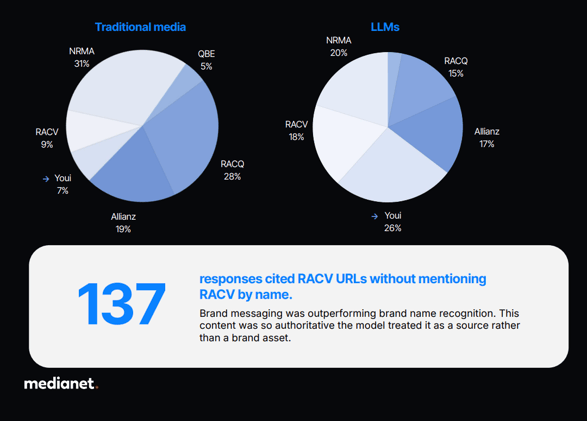 In automotive insurance, every brand's LLM share of voice diverged meaningfully from its media position with just one exception.
For RACV, it ranked first in traditional media presence at 88%, but that dropped to 42% in LLMs. Victorian Government agencies collectively outperformed it in AI citation volume despite ranking lower in traditional media share of voice.
And perhaps the most unusual finding of all was that 137 LLM responses cited RACV URLs without mentioning RACV by name at all, meaning that brand messaging was outperforming brand name recognition. The content had become so authoritative that models were treating it as a source rather than a brand asset.
Whether anonymous attribution is a problem or a sign of genuine authority depends entirely on what an organisation is trying to achieve, but it's a distinction that existing media measurement frameworks aren't fully equipped to capture.
What stands out in this landscape of measurement and adaptation is that strong media performance does not guarantee LLM visibility, and LLM visibility does not guarantee brand name recognition. They're different metrics that need to be measured separately, against competitors, on their own terms.
Opening the Black Box Phase 2 report is available now. For communications teams, public affairs professionals and brand strategists navigating this environment, it's the clearest picture yet of how AI is reshaping the reputational channel and what to do about it.
About the Author

Amena Shakir
Amena Shakir is part of the Marketing team at Medianet, where she covers PR trends, media analysis, and industry insights in Australia.
Share


.jpg?width=352&name=Learnings%20from%20Opening%20the%20Black%20Box%20Phase%202%20Webinar_FeatureImage_v31072026%20(1).jpg)

 Top
Top