

National Science Week runs from 15–23 August, and it's one of the few weeks a year when Australian science coverage genuinely widens beyond the usual health and climate stories into physics, space, biology, technology and more. If you want to follow the people doing that reporting day in and day out, here are 15 journalists worth adding to your feed.
All of them are current, active contacts in Medianet's intensive media contacts database – so if you're in PR or comms and want to add any of them to your own media list, their details are ready to go.
1. Michael Slezak – National Environment and Science Reporter, ABC News
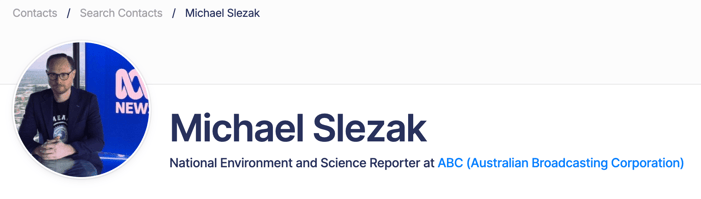
Slezak is the National Environment and Science Reporter for ABC News, filing for ABC's national newsroom across TV, radio and online. His topics of interest sit at the point where science meets policy – climate change, energy, biodiversity and environmental law all fall under his coverage. His writing coverage expands to include clean energy, biology and commentary on the CSIRO. He is also an award-winning climate journalist, including a Walkley for his work on science, environment and climate change.
-
The inside story of an ABC report that helped scuttle Australia's biggest foreign takeover.
-
Environmental law charity may be forced to shut after court costs.
2. Dr Jackson Ryan – Freelance Science & Video Game Journalist

Ryan is a highly published science journalist, writing for Guardian Australia, The Monthly and The Saturday Paper. He’s President of the Science Journalists Association of Australia, covering biomedical, marine science and video games.
3. Angus Dalton – Science Reporter, The Sydney Morning Herald

Dalton reports for The Sydney Morning Herald, with his stories syndicated across The Age and WA today, covering science, environment and climate change for a general masthead readership rather than a specialist one.
- Scientists warn of grass spreading across parts of the Antarctic.
- The two species NSW is racing to protect after the fifth case of deadly virus.
4. Tegan Taylor – Host & Reporter, ABC Listen / ABC RN Life Matters

Taylor is a health and science reporter for the ABC who spent the pandemic co-hosting Coronacast with Norman Swan, work that won a Walkley Award and the 2020 Eureka Prize for Science Journalism, including an interview with Dr Anthony Fauci that was picked up across major Australian outlets. She and Swan now co-host What's That Rash?, working through listener health questions each week, where she also contributes to ABC RN's Health Report and hosts Life Matters, a program built around social affairs and everyday life.
5. Rae Johnston – Host, ABC RN's Download This Show / SBS's The Secret DNA of Us

Johnston is a Wiradjuri STEM journalist and broadcaster with a standout voice in Australian science media. She was the first female editor of Gizmodo Australia and the first Indigenous editor of Junkee, then moved into hosting. She now presents ABC RN’s Download This Show and works on SBS’s The Secret DNA of Us, a genetics documentary series built around mass community DNA testing to uncover hidden family and historical connections.
6. Natasha Mitchell – Science Journalist, Producer & Presenter, ABC RN
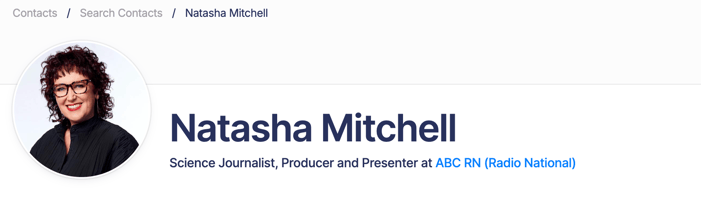
Natasha Mitchell hosts both Science Friction and Big Ideas for ABC RN – the former built around single deep-dive science stories (its 2024 episode "Hello AI Overlords" won the Eureka Prize for Science Journalism), the latter a broader program spanning ideas, policy and public debate. Her interviews tend to run long-form rather than fit a daily news cycle. Natasha is also a Member of the current Executive Advisory Board of Women in Science Australia. Having studied engineering at Monash University in Melbourne, her first foray into radio broadcasting came as a volunteer at the Monash community station 3MU, where she hosted a punk music program.
7. Michael Lucy – Science Editor, The Conversation
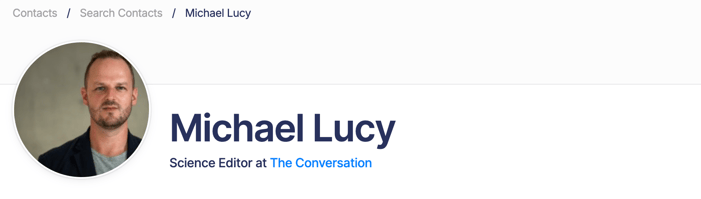
Lucy edits science coverage for The Conversation, a nonprofit outlet built around academics writing for a general audience under journalistic editing rather than journalists reporting alone. As an editor rather than a byline-first reporter, his influence runs across the outlet's science desk as much as through pieces under his own name.
8. Carl Smith – Science Reporter, ABC Science

Smith reports for ABC Science across biotechnology, psychology, computer science, medical equipment, environment and health. He also co-edited The Best Australian Science Writing 2024 alongside Jackson Ryan, an annual anthology collecting the year's Australian science writing.
9. Evrim Yazgin – Science Journalist, Cosmos (ConnectSci News)
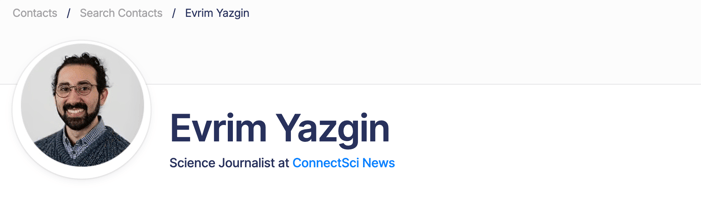
Yazgin writes for Cosmos, Australia's dedicated science magazine, which is owned by CSIRO Publishing. He brings a physics background (a maths and physics degree and a master's in physics from the University of Melbourne) to his reporting on physics, astronomy and space.
Some of his work:
-
What are the best ways to protect freshwater biodiversity?
- Hidden Australian rainforests protected by rugged terrain.
10. Imma Perfetto – Science Journalist, Cosmos (ConnectSci News)

Perfetto is one of Cosmos's generalist science journalists, covering everything from astronomy and genetics to archaeology, materials science and space exploration. She is interested in writing on subjects such as geology, meteorology, biotechnology and satellite technology.
11. Dr Karl Kruszelnicki – Presenter, triple j Dr Karl Podcast

Few names in Australian science communication are as widely recognised as Dr Karl. His weekly podcast answers listener questions across health, biology and physics, reaching younger, broader audiences than traditional science journalism. Kruszelnicki has hosted his triple j segment in some form for decades, and now answers listener questions across health, biology and physics through the weekly Dr Karl Podcast, built around audience curiosity rather than the news cycle and reaching triple j's youth audience.
12. Rebecca Dyer – Assistant Editor, ScienceAlert
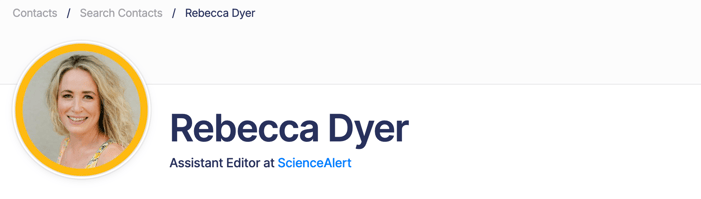
Dyer is Assistant Editor at ScienceAlert, reporting across health, biology, neuroscience and physics for the site's fast-turnaround daily coverage. She holds a Bachelor of Medical Science with a nutrition focus and is currently completing a Master of Data Science, a background that shows up in her health and cognition stories in particular.
- Cat Ownership Linked to Increased Risk of Schizophrenia, Study Suggests
- Parkinson's Discovery Suggests We May Have an FDA-Approved Treatment Already
13. Kovi Rose – Science Writer, SpaceAustralia.com

Rose writes for SpaceAustralia.com, a publication focused exclusively on space and astronomy, while also pursuing a PhD in astrophysics at the University of Sydney. That combination gives the reporting a valuable perspective as it is informed by the research itself, rather than written from a distance.
14. Lauren Davis – Editor, Lab+Life Scientist

Lauren edits Lab+Life Scientist, a trade publication for laboratory professionals and scientists rather than a general-audience outlet, covering the science industry itself with interests in equipment, research practice and the people running the labs alongside broader science and health stories.
15. Michelle Starr – Senior Journalist, ScienceAlert

Michelle Starr writes for ScienceAlert, a digital-native science news site founded in Australia that publishes multiple stories a day across physics, biology, space and technology, and republishes some of her work through Live Science internationally.
- Our Survival Might One Day Rely on Nuking a 'City Killer' Asteroid. Scientists Just Tested Whether It'll Work
- Scientists Wiggled a Fish's Earbones With Light – And Changed Its Heartbeat
Find the right Journalist for your stories with Medianet
National Science Week is the perfect opportunity for PR and comms professionals to newsjack. Science stories have the variety and depth to reach diverse readers, viewers and listeners — from a quick explainer or expert comment to a deeper feature, interview or case study. If your organisation has research, expertise or a perspective that can help make a complex issue clearer, this is the time to share it.
Start by identifying the audience you want to reach, then tailor the angle, spokesperson and format to the journalists and outlets already covering that topic. A relevant, well-timed pitch can turn a moment in the news calendar into a meaningful public conversation.
Medianet's media contacts database makes it easier to find the right journalist for your story. Our research team based in Australia continuously monitors and verifies journalist profiles, so you have access to accurate, up-to-date information on coverage areas, recent work, and the right contact details. Whether you're pitching to a national broadcaster or a specialist science publication, start with the right contact.
About the Author

Amena Shakir
Amena Shakir is part of the Marketing team at Medianet, where she covers PR trends, media analysis, and industry insights in Australia.
Share



.png?width=352&name=Brand%20design%20Blog%20post%20featured%20image%20template%20(10).png)

 Top
Top